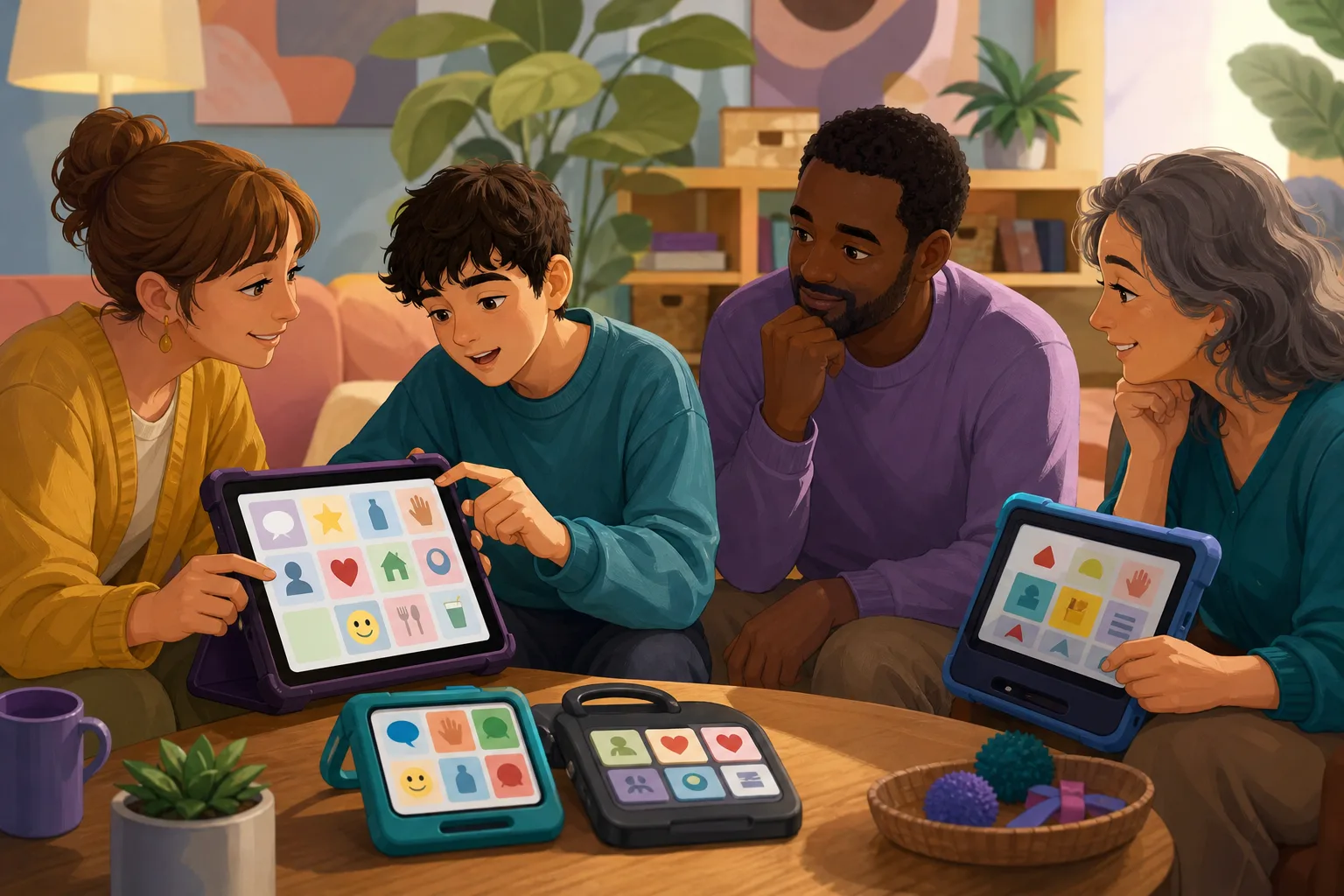
AAC Devices for Autism: Complete Family Guide 2026
What an AAC device is, how dedicated devices differ from AAC apps, what they cost, who may fund them, and how to choose the right one.
If a speech-language pathologist has recommended an AAC device for your child, you are probably facing three questions at once: what exactly is it, which one to choose, and how much it costs. This guide answers all three in plain language.
WHAT IS AN AAC DEVICE
AAC stands for Augmentative and Alternative Communication. An AAC device is any tool that lets a person communicate when speech is absent, unreliable or not functional across every situation. It ranges from a laminated board of symbols to a speech-generating device (SGD) that speaks aloud when the user taps pictograms.
Augmentative means it is added to existing speech. Alternative means it replaces speech when speech is not available. Most autistic users move between both across the day.
THE THREE FAMILIES OF AAC DEVICES
No-tech: gestures, sign, eye pointing, a paper board. Free, always available, no battery — but the listener has to know the system.
Low-tech: laminated pictogram boards, PECS binders, single-message buttons. Cheap and robust, limited vocabulary, needs printing and re-printing as the child grows.
High-tech: dedicated speech-generating devices and AAC apps on a tablet. Large vocabulary, natural synthetic voice, categories that change dynamically as you tap. This is what most therapists mean today when they say "AAC device".
DEDICATED DEVICE VS AAC APP
A dedicated AAC device is a locked-down hardware unit built only for communication, typically 3,000-9,000 USD/EUR, often funded by insurance or a public health system. Its advantages are durability, no distractions, and eligibility for funding in some countries.
An AAC app running on a standard tablet costs a fraction of that. The tablet is a device the family may already own, the app updates continuously, and the vocabulary can be edited by the family and the therapist in minutes. The main drawback is distraction, solved with guided-access or kiosk mode.
For the large majority of autistic children starting AAC, an app on a tablet is the fastest, cheapest way to begin — and starting now matters far more than starting with perfect hardware.
DOES AAC STOP A CHILD FROM TALKING?
No. This is the single most persistent myth in the field. Systematic reviews over the last two decades consistently find that AAC does not suppress speech development, and frequently supports it: it lowers frustration, teaches that communication produces results, and gives the child a model of language structure.
HOW TO CHOOSE: FIVE PRACTICAL CRITERIA
Motor access. Can the child hit a 2 cm target reliably? If not, the grid must be reducible to 4 or 6 large cells.
Visual load. Some users need dense grids to reduce navigation; others shut down with more than 9 symbols on screen. The system must allow both.
Core vocabulary. Avoid systems built only around nouns. Words like more, want, stop, help, go, look are what turn tapping into real communication.
Colour coding. The Fitzgerald Key (yellow for people, green for actions, blue for descriptors, orange for nouns, pink for social words) lets a pre-reader find words by colour zone. It measurably accelerates sentence building.
Shared editing. Family and therapist should work on the same board. A vocabulary the SLP adds in session should be on the home tablet the same evening.
THE FIRST 30 DAYS
Week 1-2: aided language modelling only. You tap symbols while you speak and ask for nothing in return. The child learns by watching, just as they learned to hear speech before producing it.
Week 3: honour every attempt, including "mistakes". If they tap "water" while looking at a biscuit, give the water. The lesson being taught is that the device changes the world.
Week 4: add descriptors and start two-symbol combinations (want + biscuit). Do not chase long sentences; chase frequency.
HOW AUTISMDOCK FITS IN
AutismDock includes a full AAC communication board with 500+ ARASAAC pictograms, Fitzgerald colour coding, natural voices in five languages, adjustable grid density, real-photo pictograms and a synchronized profile shared between the family's phone, the tablet and the therapist's browser. You can try the board in the browser without installing anything, and print low-tech backups from the same vocabulary so home, school and the car all use one consistent system.
Start with eight words, model without demanding, and keep the device within reach. Everything else follows from there.
Explore our latest articles on autism awareness, research, therapies, and community stories.
AutismDock →Autism blog: practical guides
AAC Device Cost: Tablet Prices & Funding
💬 CommunicationBest Free AAC App for Autism: How to Choose
💬 CommunicationEcholalia and Gestalt Language Processing: How Kids Learn
💬 CommunicationEarly Communication in Autism: What to Do Before First Words
💬 CommunicationSocial Stories for the Dentist, Doctor, and Hairdresser
💬 CommunicationNon-verbal communication in autism: what it means and how to help
AutismDock is free and ad-free. If it helped, you can support it →