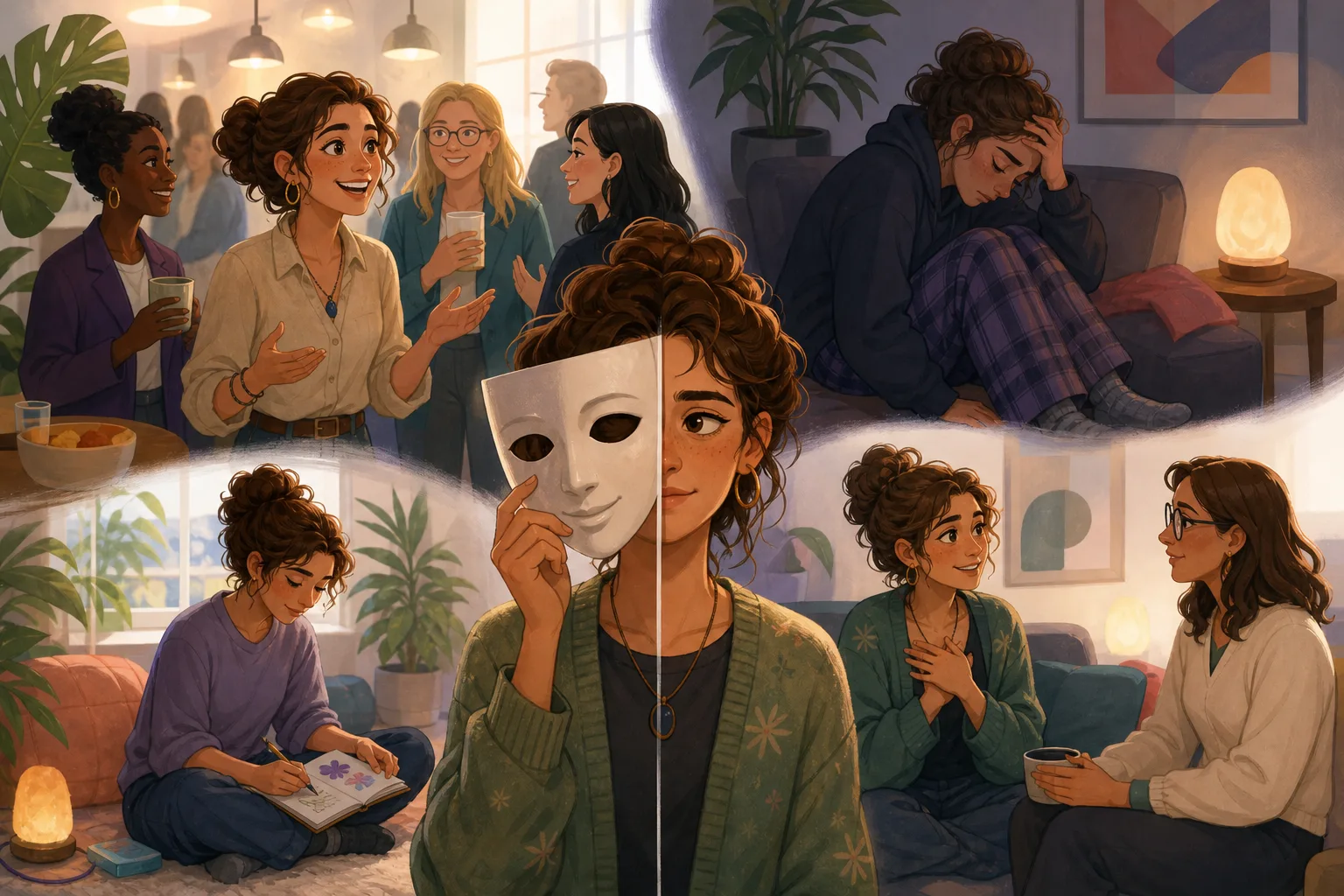
Social Masking in Autistic Women: What It Is and Why It Happens
Social masking helps explain why many autistic women go unnoticed and end up exhausted. What it is, how it shows up, and what it costs.
Social camouflaging, or masking, is the set of conscious and unconscious strategies an autistic person uses to appear non-autistic. It's the single factor that best explains why women are diagnosed twenty years later than men.
THE THREE PARTS OF CAMOUFLAGING
Compensation: using learned strategies to cover difficulties, such as rehearsing conversation scripts or memorising social rules.
Masking: hiding autistic traits, such as suppressing stimming, forcing eye contact, or controlling tone of voice.
Assimilation: forcing yourself to fit into unbearable situations, such as staying at a party in sensory overload so you don't seem odd.
WHAT IT LOOKS LIKE IN REAL LIFE
Mentally rehearsing a phone call. Copying a colleague's way of speaking. Laughing half a second late because the joke had to be processed. Mirroring posture. Preparing three anecdotes before a dinner. Counting seconds of eye contact. Enduring uncomfortable shoes all evening. Saying "I'm fine" automatically while your body screams.
WHY WOMEN MASK MORE
It isn't biological but social: girls are expected from a very early age to be kind, empathetic, attentive, and pleasant. A girl who falls short receives immediate, constant social correction, so she learns earlier and more precisely how to build an acceptable version of herself.
THE COST
Research links high camouflaging with anxiety, depression, autistic burnout, loss of identity, and greater risk of suicidal ideation. It also produces two cruel side effects: diagnosis is delayed because nobody sees the autism, and when you finally say it, people reply "you don't look autistic."
There's a third, less-discussed cost: disconnection from yourself. After twenty or thirty years of performing, many women don't know what they genuinely like, what bothers them, or what they need.
HOW TO UNMASK WITHOUT BREAKING YOUR LIFE
-
Take an inventory. For one week, note every time you do something purely to seem normal. The list is usually devastating and very revealing.
-
Safe zones. Start at home: free stimming, comfortable clothes, low lighting, no obligation to reply instantly.
-
Unmask in layers. Pick one small element and drop it in a safe context: stop forcing eye contact with your partner, wear headphones at the supermarket, say out loud that a place is too loud for you.
-
Substitute, don't suppress. If visible stimming feels uncomfortable in public, use discreet versions (an object in your pocket, foot movement) instead of shutting it down completely.
-
Prepare boundary phrases. "I'm leaving in half an hour, that's my noise limit." Having the sentence ready avoids improvising mid-overload.
-
Choose who gets the unfiltered version. Not everyone deserves access. Start with one or two safe people.
THE MIDDLE PHASE IS UNCOMFORTABLE
Unmasking usually brings an awkward stage: more social clumsiness, more emotional tiredness, sometimes reactions from others. It's temporary and part of getting your energy back over the medium term.
HOW AUTISMDOCK HELPS
Mood logging lets you compare high-masking days with low-masking days and see the real impact on energy. With that data it becomes much easier to justify boundaries, workplace adjustments, and rest, both to others and to yourself.
THE BOTTOM LINE
Masking has protected you and it has also drained you. It doesn't need to disappear overnight: it needs to become a conscious choice rather than an automatic reflex.
Explore our latest articles on autism awareness, research, therapies, and community stories.
AutismDock →Autism blog: practical guides
Autism and ADHD in Women: Why They're Confused and Combined
🧠 Mental HealthAlexithymia and Autism: When Feelings Are Hard to Name
🧠 Mental HealthSelf-esteem in autism: how to build a healthy identity
🧠 Mental HealthAnxiety in autistic children: signs, causes, and how to help
🧠 Mental HealthParental Burnout in Autism Families: Signs and Support
🧠 Mental HealthAutism in Adolescence: Common Changes and How to Support
AutismDock is free and ad-free. If it helped, you can support it →