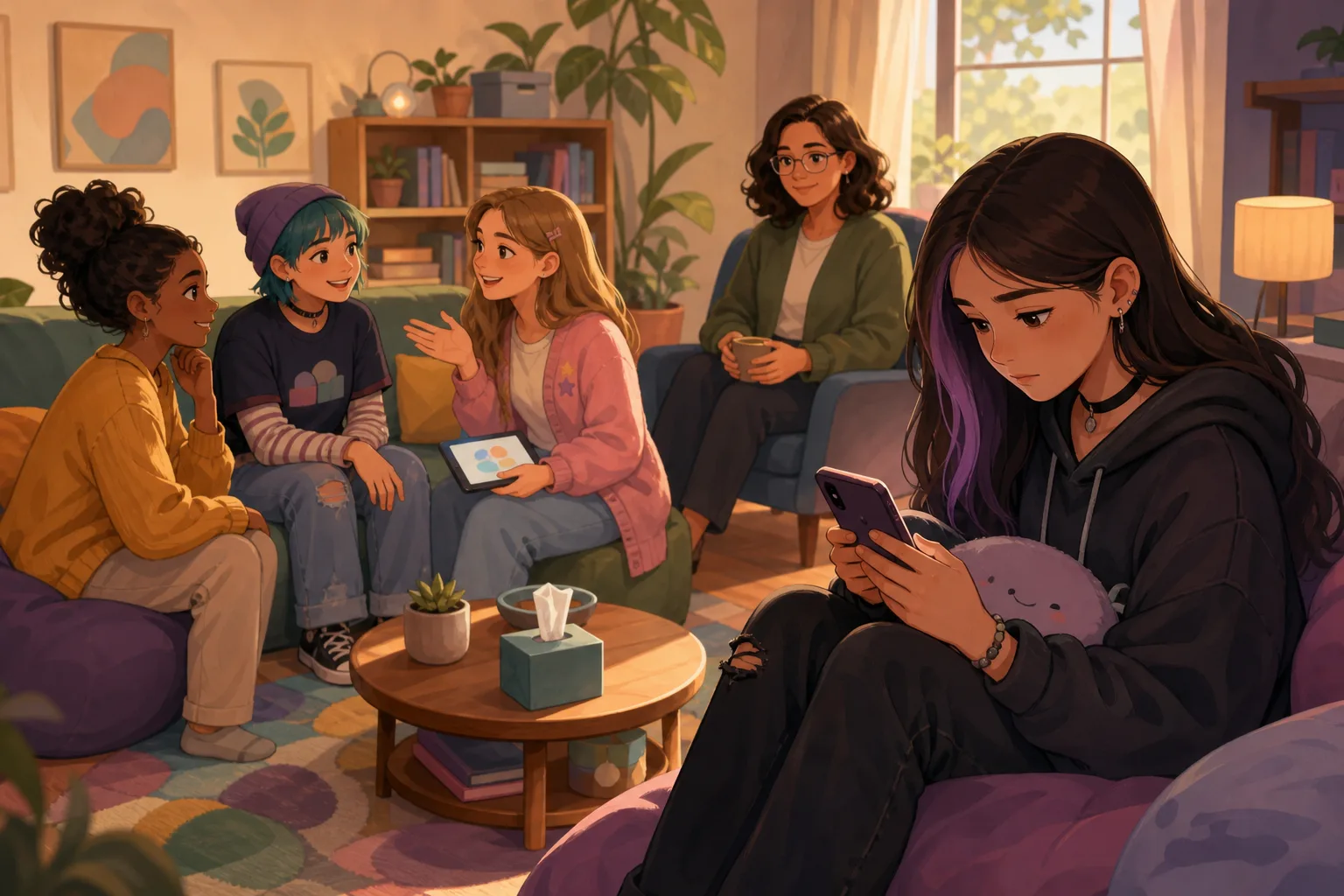
Autistic Teenage Girls: Signs, Changes and Support
Adolescence can be especially hard for autistic girls as social rules change. Learn the signs to watch for and how to support her.
Many autistic girls get through childhood without drawing attention and fall apart in adolescence. It isn't that autism suddenly appears: it's that social rules become implicit, shifting, and cruel, and the strategies that used to work stop working.
WHAT CHANGES AT 12-16
In primary school friendships are built on shared activities. In secondary school they're built on codes: who talks to whom, irony, hierarchies, non-verbal language, and a conversational speed that's hard to follow. Add puberty, with sensory and hormonal change, a heavier academic load, and less adult supervision.
The typical result: a girl who was "a good, quiet student" starts having anxiety, Sunday-night stomach aches, school avoidance, or meltdowns at home after holding it together all day.
WARNING SIGNS
Extreme exhaustion on arriving home, with meltdowns or silence. Changes in eating. Self-harm or compulsive skin picking. Total isolation at weekends. Intense fear of the canteen, the playground, or changing rooms. Comments like "I'm weird" or "I don't know how other people talk." Friendships that use or mock her without her noticing. Grades dropping with no academic cause.
FRIENDSHIPS: THE MOST PAINFUL PART
Many autistic girls have enormous loyalty and a literal expectation of reciprocity, so they suffer especially with group dynamics, ghosting, and ambiguous jokes. They're also more vulnerable to unequal friendships where they always carry the effort.
What helps: a few good friendships rather than many shallow ones; spaces organised around an interest (drama, animals, drawing, gaming, music) where interaction has structure; and one adult to review confusing situations with, without judgement.
SOCIAL MEDIA
It's both refuge and risk. A refuge because it allows asynchronous communication, without noise or face-reading, and access to autistic community. A risk because of literal interpretation of ambiguous messages, exposure to bullying, difficulty spotting manipulation, and content about eating and self-harm.
Rather than banning, accompanying works better: review privacy settings together, agree what to do if someone asks for photos or private contact, and practise concrete phrases for ending uncomfortable conversations.
MENTAL HEALTH AND SAFETY
Autistic teenage girls have higher rates of anxiety, depression, and eating disorders than their peers. They're also more vulnerable to abusive relationships, because they've learned that saying no causes conflict. Explicit, literal, metaphor-free sex education is a protective measure, not a luxury.
HOW TO SUPPORT WITHOUT OVERWHELMING
Reduce demands at home after hard school days: home should be the place where no performance is required. Offer decompression before asking how it went; many need an hour of silence first. Validate social tiredness instead of encouraging more socialising. Negotiate accommodations with the school: an alternative lunch space, leaving class two minutes early, a calm room, permission for headphones.
USEFUL TOOLS
Daily mood logging to catch overload weeks before a crisis, visual morning routines, and sensory calm spaces. AutismDock offers these in a teen mode without childish styling, which matters enormously at this age.
THE BOTTOM LINE
If your daughter holds it together all day and explodes at home, home isn't the problem: it's the only place she can stop pretending.
Explore our latest articles on autism awareness, research, therapies, and community stories.
AutismDock →Autism blog: practical guides
Autism paperwork: diagnosis, disability assessment and benefits
❤️ HealthAutism and Hormones in Women: Periods, Pregnancy and Menopause
🧠 Mental HealthAutism and ADHD in Women: Why They're Confused and Combined
🧠 Mental HealthSocial Masking in Autistic Women: What It Is and Why It Happens
🌱 AdulthoodAutism in Adult Women: Signs and Why Diagnosis Is Late
🌱 AdulthoodAutistic Burnout in Adults: Signs, Causes and Recovery
AutismDock is free and ad-free. If it helped, you can support it →